Watching your child ride a tricycle for the first time is an exciting parenting milestone. Learning to pedal, steer, and move independently takes practice, but with patience and encouragement, how to teach your kids to ride a tricycle can become a fun experience for the whole family.
Thank you for reading this post, don't forget to subscribe!If you’re wondering how to teach your kids to ride a tricycle, the key is to start slowly and make each practice session enjoyable.
This post may contain affiliate links. If you purchase through these links, we may earn a small commission at no extra cost to you. We only recommend products that we genuinely believe provide value to parents and children.
Why Riding a Tricycle Is Good for Kids
Riding a tricycle is more than just a fun outdoor activity. It gives children an opportunity to develop physical skills while building confidence and independence.
As your child pedals, they strengthen their legs and improve coordination. Steering helps develop hand-eye coordination, while learning to move around objects encourages spatial awareness and problem-solving.
Tricycle riding can also help children become more confident in their physical abilities. When they realize they can control where they go and how fast they move, they begin to feel more independent.
If you’re looking for other activities and toys that support early development, you can also read our guide to Top 10 Educational Toys for Babies.
The most important thing is to remember that children develop at different speeds. Your goal isn’t to create a perfect rider immediately. Instead, give your child opportunities to practice, explore, and enjoy the process.
What Age Should Kids Start Riding a Tricycle?
Many children are ready to begin learning between 2 and 3 years old, although readiness varies from child to child.
Some toddlers may show interest earlier, while others need more time to develop the balance, coordination, and leg strength needed to pedal and steer.
Rather than focusing only on age, look for signs that your child is ready.
Your child may be ready to try a tricycle if they can:
- Sit comfortably without support
- Walk and move confidently
- Follow simple instructions
- Reach the pedals comfortably
- Hold and turn handlebars
- Show interest in riding toys
- Understand simple safety instructions
Don’t worry if your child isn’t ready at exactly the same age as another child. Learning should be based on your child’s development rather than comparison.
Choose the Right Tricycle for Your Child
Before you start teaching your child, make sure the tricycle is the right size and provides good stability.
A tricycle that is too large can make learning uncomfortable and difficult. Your child’s feet should be able to reach the pedals without stretching, and they should be able to sit comfortably while holding the handlebars.
When choosing a toddler tricycle, look for:
- Wide and stable wheels
- A comfortable seat
- Easy-to-use pedals
- Non-slip pedals
- Easy steering
- A sturdy frame
- Appropriate safety features
- An adjustable seat if possible
A model with an adjustable seat can be useful because it may continue to fit your child as they grow.
For beginners, a tricycle with a parent push handle can also provide additional support while your child is learning.
👉 Check out these toddler tricycles and compare their features before choosing one for your child.
How to Teach Your Kids to Ride a Tricycle Safely
Safety should come before speed.
For the first few practice sessions, choose a flat and quiet area away from traffic. A driveway, empty playground, quiet sidewalk, or other suitable open space can work well.
Before your child begins riding, check the area for:
- Rocks
- Sticks
- Uneven surfaces
- Toys
- Puddles
- Steep slopes
- Cars and other traffic
Your child should also wear appropriate protective equipment.
A properly fitted helmet is especially important. Closed-toe shoes can help protect little feet and provide better contact with the pedals.
For additional guidance on tricycle safety, see the American Academy of Pediatrics’ tricycle safety tips for children.
You can also consider knee and elbow protection during the early learning stage.
Understanding how to teach your kids to ride a tricycle becomes much easier when you break the process into small, manageable steps.
If you regularly take younger siblings along on family outings, our guide to Best Baby Strollers for Newborns can help you prepare for comfortable family walks.
How to Teach Your Kids to Ride a Tricycle Step by Step
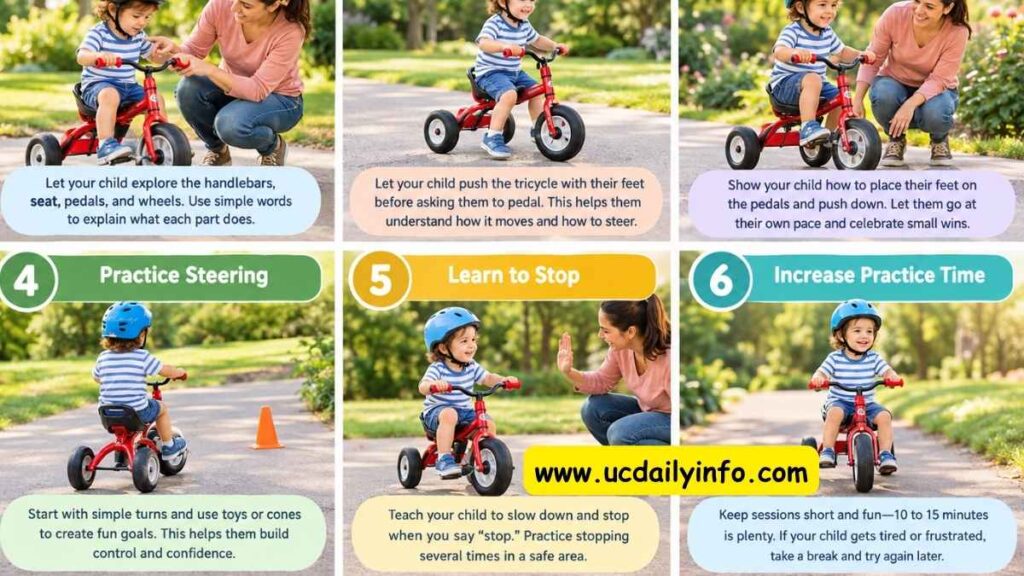
Once you have the right tricycle and a safe practice area, it’s time to begin.
Don’t expect your child to master everything during the first session. Break the process into small steps.
1. How to Teach Your Kids to Ride a Tricycle by Starting Slowly
Start by allowing your child to sit on the tricycle without worrying about movement.
Let them explore the handlebars, seat, pedals, and wheels.
You can explain what each part does using simple language.
For example:
“Hold the handlebars.”
“Put your feet on the pedals.”
“Let’s turn the handlebars this way.”
This helps the tricycle feel familiar before your child has to think about moving.
2. How to Teach Your Kids to Ride a Tricycle by Starting Slowly
One of the easiest ways to introduce riding is to let your child move the tricycle with their feet.
Instead of immediately asking them to pedal, encourage them to sit on the seat and push against the ground with their feet.
This gives them an opportunity to understand how the tricycle moves and how steering affects direction.
Once they become comfortable moving forward, you can gradually introduce pedaling.
3. Teach Pedaling Slowly
Pedaling can be difficult for toddlers at first because it requires coordination between both legs.
Place your child’s feet correctly on the pedals and show them how pushing down makes the tricycle move.
You can gently help them get the first few pedal movements started.
Avoid pushing the tricycle too quickly. Slow movement gives your child more time to understand what is happening.
Celebrate small achievements, such as completing one full pedal rotation.
4.How to Teach Your Kids to Ride a Tricycle by Practicing Steering
Once your child understands basic movement, help them practice steering.
Start with simple turns rather than complicated routes.
You can place a toy or soft object a short distance away and ask your child to ride toward it.
Then encourage them to turn around and come back.
This turns steering practice into a simple game.
5. How to Teach Your Kids to Ride a Tricycle by Learning to Stop
Learning how to stop is just as important as learning how to move.
Teach your child to slow down and stop when you give a simple instruction such as “stop.”
Depending on the tricycle design, stopping may involve stopping pedaling and placing their feet on the ground.
Practice stopping several times in a safe area before allowing longer rides.
6. Gradually Increase Practice Time
Young children can lose interest quickly, especially when they’re learning a new physical skill.
Keep early sessions short and enjoyable.
Even 10 to 15 minutes of focused practice can be useful.
If your child becomes tired or frustrated, stop and try again another day.
There is no need to turn every family outing into a training session.
How to Teach Your Kids to Ride a Tricycle Through Play
Children often learn best when they’re having fun.
Instead of saying, “It’s time for tricycle practice,” turn the activity into a small adventure.
You could:
- Create a simple chalk path
- Place soft toys around the yard
- Pretend your child is delivering packages
- Set up a simple route between cones
- Ask your child to ride to a favorite toy
- Play follow-the-leader
- Create a pretend neighborhood route
For example, place a few stuffed animals around the practice area and ask your child to “visit” each one.
This gives them a reason to pedal, steer, stop, and turn without making the activity feel like a lesson.
Positive experiences can also help children become more confident when trying new skills. For more ideas, read our guide to Parenting Advice for Raising Confident Kids.
How to Teach Your Kids to Ride a Tricycle With Positive Encouragement
It’s natural to want to help when your child struggles.
However, doing everything for them can prevent them from developing confidence and independence.
Instead of immediately grabbing the handlebars or pushing the pedals, give your child a few seconds to figure things out.
Use encouraging phrases such as:
- “You’re getting better.”
- “Try again.”
- “You almost did it.”
- “Great job turning.”
- “You figured that out.”
- “Let’s try it together.”
Focus on effort rather than perfection.
If your child makes a mistake, avoid making them feel embarrassed. Learning a new physical skill involves plenty of wobbles, wrong turns, and stops.
The goal is to help your child feel capable enough to keep trying.
Common Mistakes When Teaching Your Kids to Ride a Tricycle
Learning how to teach your kids to ride a tricycle becomes easier when you know what not to do.
Expecting Your Child to Learn Immediately
Some children may understand pedaling quickly, while others need several practice sessions.
Don’t assume that struggling during the first few attempts means your child isn’t capable of learning.
Give them time.
Using a Tricycle That’s Too Large
Buying a larger tricycle so your child can “grow into it” may seem economical, but oversized equipment can make learning harder.
Your child should be able to reach the pedals and comfortably control the handlebars.
Practicing for Too Long
Long practice sessions can turn an enjoyable activity into a frustrating one.
Short, regular sessions are often easier for young children.
Comparing Your Child With Other Kids
Avoid statements such as:
“Your friend can already ride.”
“Your brother learned faster.”
Every child develops differently.
Comparisons can make children feel pressured when they should be developing confidence.
Focusing Only on Speed
Speed isn’t the goal during the early stages.
Your child should first learn to control the tricycle, steer, and stop safely.
Once those skills improve, speed will naturally develop.
How to Tell If Your Child Is Learning to Ride a Tricycle
Progress may be gradual, but you’ll begin to notice small changes.
Your child may start to:
- Pedal for longer periods
- Steer without your help
- Make wider and smoother turns
- Stop when asked
- Look ahead instead of constantly watching their feet
- Recover from small mistakes
- Ask to ride more often
These are all encouraging signs.
You don’t need to wait until your child can ride perfectly before celebrating their progress.
Even one successful turn or a few independent pedal strokes are worth recognizing.
When to Move From Practice to Longer Rides
Once your child can pedal, steer, and stop with reasonable control, you can gradually introduce longer rides.
Start with familiar areas where you can closely supervise them.
Continue avoiding busy roads and areas with heavy traffic.
As your child gains confidence, you can introduce different surfaces and slightly longer routes while continuing to prioritize safety.
Remember that confidence should come from improved control, not simply from spending more time on the tricycle.
Useful Accessories for Young Tricycle Riders
A few accessories can make riding more comfortable and enjoyable.
A Properly Fitted Helmet
A helmet is one of the most important pieces of protective equipment for young riders.
Parents can also learn more about choosing and fitting a bicycle helmet for kids
Make sure it fits properly and is appropriate for your child’s size.
A Tricycle Basket
A small basket can turn an ordinary ride into a pretend adventure.
Your child can carry a favorite toy, small snack, or other lightweight item.
Protective Pads
Knee and elbow pads can provide additional protection during the early learning stage, especially when children are still developing control.
Reflective Accessories
If your family rides in low-light conditions, reflective accessories can improve visibility. However, young children should always ride in safe, appropriate areas and under adult supervision.
👉 Browse toddler helmets, safety pads, and tricycle accessories to find options suitable for your child’s riding stage.
What to Look for in a Toddler Tricycle
If you’re choosing a tricycle for your child, focus on practical features rather than simply choosing the most expensive model.
A good toddler tricycle should provide:
- Stability
- Comfortable seating
- Appropriate sizing
- Easy steering
- Reliable pedals
- A sturdy frame
- Features that suit your child’s current ability
An adjustable design can be particularly useful because children grow quickly.
However, don’t assume that more features automatically mean a better tricycle. The most important consideration is whether your child can comfortably and safely use it.
Frequently Asked Questions
What is the best age to teach a child to ride a tricycle?
Many children begin learning between ages 2 and 3, but readiness varies. Look for signs such as good walking ability, interest in riding toys, basic coordination, and the ability to follow simple instructions.
How long does it take a toddler to learn to ride a tricycle?
There is no fixed timeline. Some children learn within a few practice sessions, while others may need several weeks. Short, positive practice sessions can help children progress without becoming frustrated.
Should a toddler wear a helmet on a tricycle?
Yes. A properly fitted helmet is an important part of riding safety. Choose a helmet designed for your child’s size and make sure it fits correctly.
Should I push my child while they are learning?
A parent push handle can be useful for giving beginners support, but gradually allow your child to control the tricycle as their skills improve. Avoid doing all the steering or movement for them.
What if my child is afraid of the tricycle?
Don’t force them to ride. Let your child sit on the tricycle, touch the handlebars, and become familiar with it first. You can also turn practice into a game and allow them to progress at their own pace.
How often should my child practice riding?
Short, regular sessions can work well. Even 10 to 15 minutes of enjoyable practice can help. If your child becomes tired or frustrated, take a break and try again later.
Final Thoughts: Help Your Child Enjoy the Ride
Learning how to teach your kids to ride a tricycle isn’t about how quickly your child can pedal across the driveway. It’s about giving them a safe opportunity to develop coordination, confidence, independence, and a love of outdoor play.
Start with the right-sized tricycle and a safe practice area. Then introduce riding gradually, beginning with simple movement before progressing to pedaling, steering, and stopping.
Most importantly, be patient.
Your child may wobble, stop, turn the wrong way, or decide they’d rather play with something else. That’s all part of learning.
Celebrate the small victories, keep practice fun, and let your child progress at their own pace. Before long, those first uncertain pedal strokes can turn into confident rides filled with smiles and excitement.
Enjoy the journey: one pedal at a time!
If you enjoyed this guide, follow UC Daily Info on Pinterest for more parenting ideas, kids’ activities, family tips, and helpful guides for everyday life.