Kitchen Science Experiments for Kids
Thank you for reading this post, don't forget to subscribe!Learning science doesn’t require an expensive laboratory or a cabinet full of special equipment. Your kitchen is already filled with amazing materials that can introduce children to chemistry, physics, biology, and engineering in exciting, hands-on ways.
Kitchen science experiments help children develop curiosity, observation skills, creativity, and critical thinking while having fun. Whether you’re homeschooling, looking for weekend activities, or simply want to spend quality family time together, these simple experiments are educational and entertaining.
The best part? Most of these activities use ingredients you already have in your pantry, making them affordable for every family.
Throughout this guide, you’ll discover easy kitchen science experiments suitable for children of different ages, including preschoolers. You’ll also learn the science behind each experiment so your child understands why it works, not just how to do it.
This post contains affiliate links. If you purchase through these links, we may earn a small commission at no extra cost to you.
Kitchen Science Experiments for Kids

Kitchen science is one of the easiest ways to introduce STEM learning at home. Children naturally enjoy mixing, pouring, stirring, and observing changes. These everyday actions become valuable learning experiences when paired with simple scientific explanations.
Instead of memorizing facts, kids get to explore science through hands-on discovery. They begin asking questions like:
- Why did it bubble?
- Why did the color change?
- Why is this floating?
- What happens if we use more water?
These questions encourage curiosity, which is the foundation of lifelong learning.
Benefits of Kitchen Science
Kitchen experiments help children:
- Build problem-solving skills
- Learn observation techniques
- Improve fine motor coordination
- Practice measuring and counting
- Understand cause and effect
- Develop confidence through discovery
- Enjoy educational screen-free activities
Because the experiments are short and interactive, they work well for busy families and children with shorter attention spans.
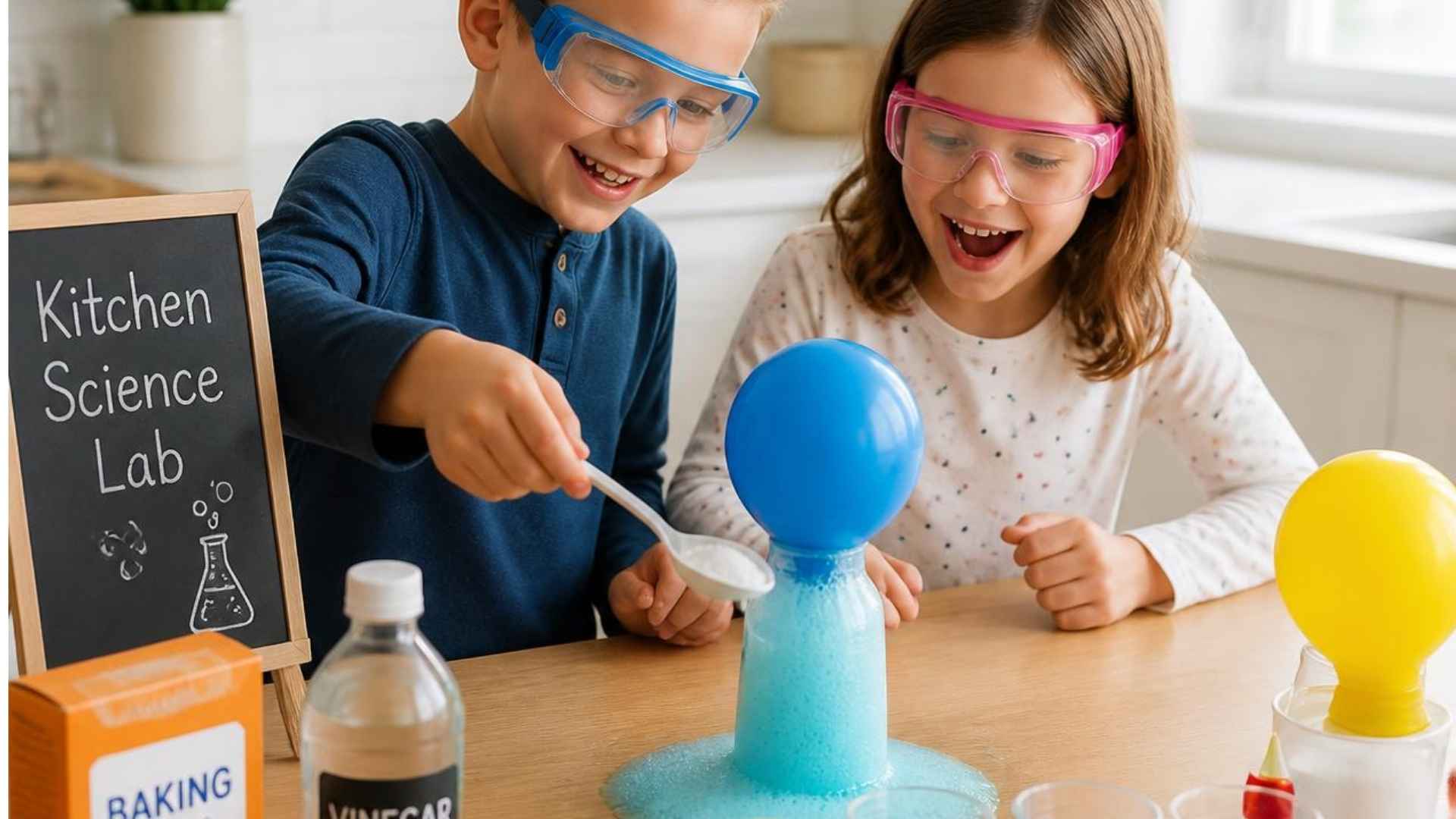
Easy Experiment: Fizzy Balloon
You’ll Need
- Baking soda
- Vinegar
- Balloon
Instructions
- Pour vinegar into a plastic bottle.
- Add baking soda inside a balloon using a small funnel.
- Carefully attach the balloon to the bottle without spilling the baking soda.
- Lift the balloon so the baking soda falls into the vinegar.
- Watch the balloon inflate on its own.
The Science
When baking soda and vinegar mix, they produce carbon dioxide gas. Since the gas has nowhere to escape, it fills the balloon and causes it to expand.
This experiment teaches children about:
- Chemical reactions
- Gas formation
- Pressure
- Observation
Parent Tip
Before starting, ask your child:
“Do you think the balloon will get bigger or stay the same?”
Making predictions helps children think like scientists.
Our Favorite STEM Product
A Kids Science Experiment Kit is a great companion for home learning. Many include safety goggles, measuring tools, pipettes, and simple experiment guides that make STEM activities even more engaging.
👉 Check today’s price here:
Related Reading: If your child enjoys hands-on learning, don’t miss our guide on Educational Learning Tablets for Kids, where we share interactive devices that combine education with fun.
Kitchen Science Experiments Kids Will Love
Children remember lessons best when they’re fun. That’s why colorful, bubbly, and surprising science experiments often become family favorites.
One of the easiest ways to capture a child’s attention is with experiments that create dramatic visual effects.
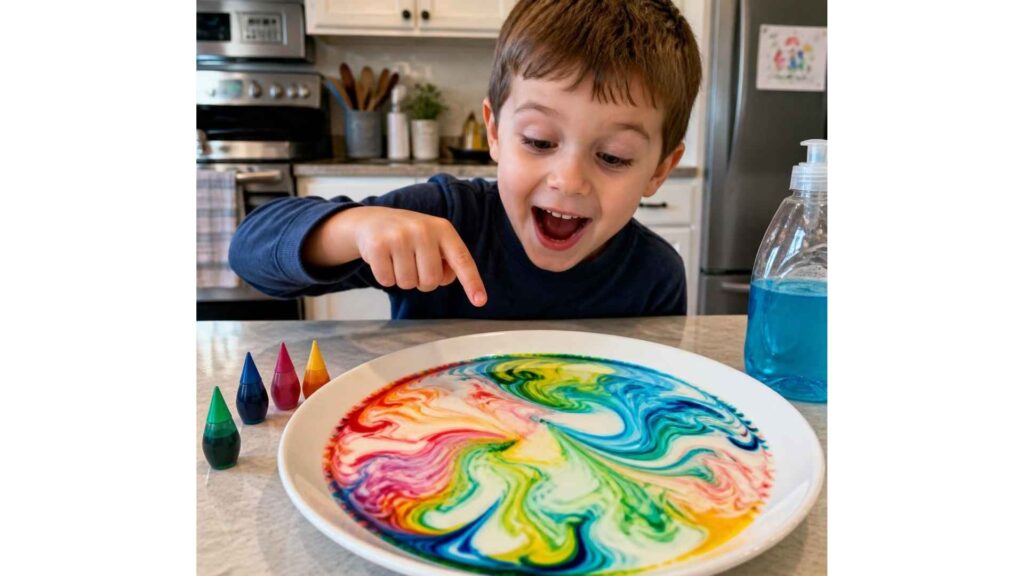
Rainbow Milk Experiment (Kitchen Science Experiments for Kids)
Ingredients
- Whole milk
- Food coloring
- Dish soap
Instructions
- Pour milk into a shallow plate.
- Add drops of different food coloring.
- Dip a cotton swab into dish soap.
- Touch the center of the milk.
Within seconds, the colors begin swirling around the plate like fireworks.
Why Does It Work?
Milk contains tiny fat molecules.
Dish soap breaks apart the fat, causing movement throughout the liquid. As the soap spreads, it carries the food coloring with it, creating beautiful swirling patterns.
Children learn about:
- Surface tension
- Fat molecules
- Chemical reactions
- Color movement
Questions to Ask
- Which color moved first?
- What happens if you use more soap?
- Does skim milk work the same way?
Simple conversations like these strengthen scientific thinking.
Family Challenge on a Kitchen Science Experiments for Kids
Try the experiment with different kinds of milk and compare the results.
Record observations in a science notebook.
Recommended Product
A children’s science journal makes it easy for kids to draw pictures, write predictions, and record what they learned after each experiment.
Related Reading: Looking for more educational fun? Explore our article on Best Kids Tablet for Learning for interactive learning games and STEM apps.
Easy Kitchen Science Experiments Anyone Can Try
Science doesn’t have to be complicated. Even the simplest activities can teach valuable lessons about chemistry, physics, and biology.
One experiment that children of all ages enjoy is making raisins “dance.”
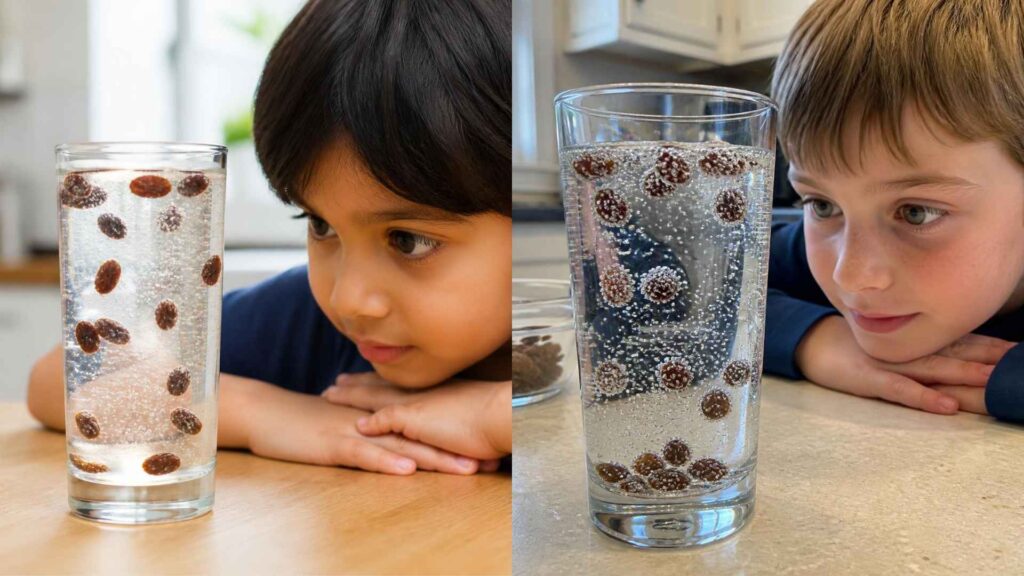
Dancing Raisins (Kitchen Science Experiments for Kids)
You’ll Need
- Clear soda
- Raisins
- Clear drinking glass
Instructions
- Fill a clear glass with soda.
- Drop several raisins into the glass.
- Watch closely.
The raisins begin rising and falling repeatedly.
Why It Happens
Tiny carbon dioxide bubbles stick to the raisins.
As more bubbles collect, they lift the raisins toward the surface. Once the bubbles pop, the raisins sink again.
This cycle repeats several times.
Children discover:
- Buoyancy
- Density
- Gas bubbles
- Floating and sinking
Encourage your child to compare raisins with grapes, corn kernels, or dried cranberries to see if they behave differently.
Science is all about asking questions, making observations, and trying new ideas. With just a few everyday ingredients, your kitchen can become a place where children build confidence, solve problems, and discover how the world works through fun, hands-on experiences.
Science Experiments With a Mud Kitchen for Kids
A mud kitchen is one of the best outdoor learning spaces for young children. It combines imaginative play with real science, allowing kids to mix natural materials, observe changes, and experiment freely. Unlike indoor activities, mud kitchens encourage children to explore nature while developing problem-solving and sensory skills.
Parents often think a mud kitchen is just for pretend cooking, but it can also become an outdoor science lab. Leaves, flowers, soil, water, sticks, and stones all provide opportunities for exciting STEM learning.
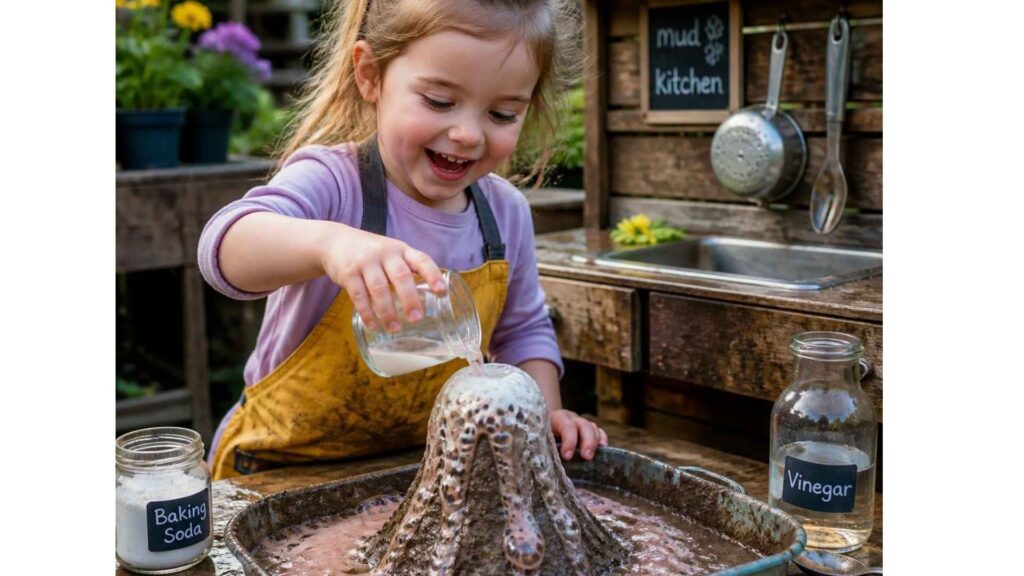
Mud Volcano Experiment (Kitchen Science Experiments for Kids)
You’ll Need
- Soil or mud
- Baking soda
- Vinegar
Instructions
- Shape wet mud into a small volcano.
- Create a small hole in the center.
- Add two tablespoons of baking soda.
- Slowly pour vinegar into the opening.
- Watch the muddy volcano erupt.
Children love seeing the bubbling “lava” flow through the mud.
The Science Behind It
This experiment demonstrates an acid-base reaction. Baking soda (a base) reacts with vinegar (an acid), producing carbon dioxide gas. The gas forms bubbles that push the muddy mixture upward, creating an exciting volcanic eruption.
Learning Skills
Children practice:
- Scientific observation
- Outdoor exploration
- Cause and effect
- Creativity
- Problem-solving
Nature Challenge
Encourage your child to decorate the volcano using:
- Small rocks
- Leaves
- Twigs
- Flowers
- Grass
This combines science with creativity and imaginative play.
Recommended Outdoor STEM Product
A wooden mud kitchen playset gives children a dedicated outdoor space for experiments, sensory play, and imaginative cooking. Many include shelves, mixing bowls, and pretend cooking accessories that inspire hours of educational fun.
👉 Explore outdoor mud kitchens here:
Related Reading: If your child enjoys outdoor educational activities, check out our guide on Harvest-Themed Preschool Activities for more seasonal learning ideas.
Fun Kitchen Science Experiments for Curious Young Minds
Children are naturally curious. They enjoy asking questions, making predictions, and discovering surprising results. Fun experiments help satisfy that curiosity while teaching valuable science concepts.
One activity that never fails to amaze is making colorful water “walk.”
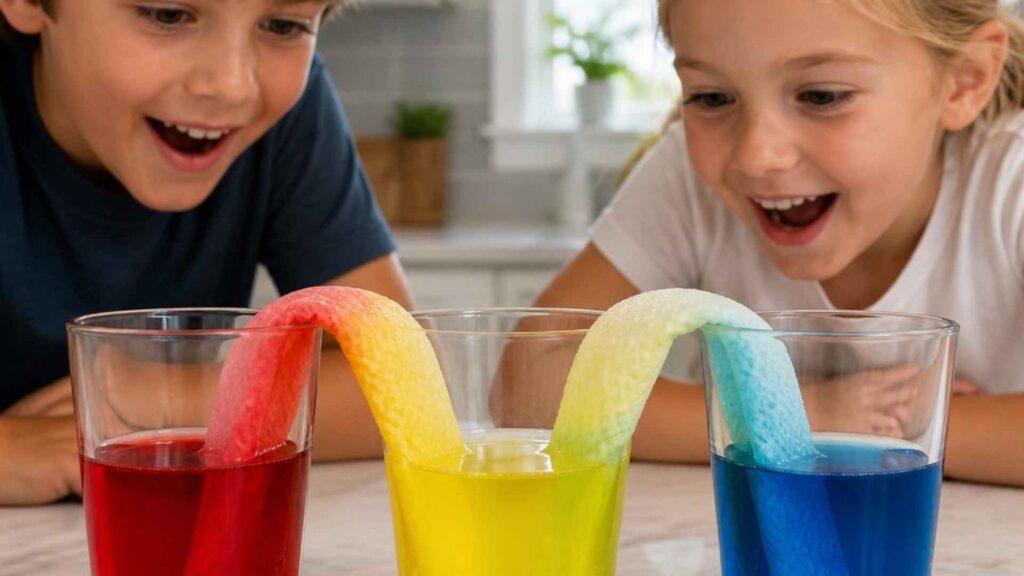
Walking Rainbow Water (Kitchen Science Experiments for Kids)
Ingredients
- Water
- Food coloring
- Paper towels
Instructions
- Fill three clear glasses halfway with water.
- Add blue food coloring to one glass and yellow to another.
- Leave the center glass empty.
- Fold paper towels into strips.
- Place one end into the colored water and the other into the empty glass.
- Wait and observe.
Over time, the colored water travels through the paper towels and mixes in the middle glass to create a new color.
The Science on a Kitchen Science Experiments for Kids
The paper towel contains tiny spaces called capillaries.
Water naturally travels through these spaces in a process known as capillary action. This is the same process plants use to transport water from their roots to their leaves.
Children learn about:
- Capillary action
- Water movement
- Plant science
- Color mixing
Ask Your Child
- Which color reached the middle first?
- What new color appeared?
- Would warm water move faster?
- What happens if you use different paper towels?
Questions like these encourage critical thinking and observation.
Family STEM Tip
Create a simple science journal where children draw the experiment before and after. Recording observations helps reinforce what they’ve learned and builds early scientific skills.
Recommended Learning Product
A children’s microscope is a fantastic next step for curious kids. They can examine leaves, flowers, fabrics, and everyday objects more closely, extending the excitement of hands-on science beyond kitchen experiments.
👉 See beginner microscopes for kids:
Related Reading: Continue the learning with our article on Kids Learning Tablet, featuring educational apps and STEM games that complement hands-on science activities.
Simple Science Kitchen Experiments Using Everyday Ingredients
One of the biggest advantages of kitchen science is that you don’t need expensive equipment. Everyday ingredients found in most homes can create fascinating experiments that introduce children to important scientific concepts.
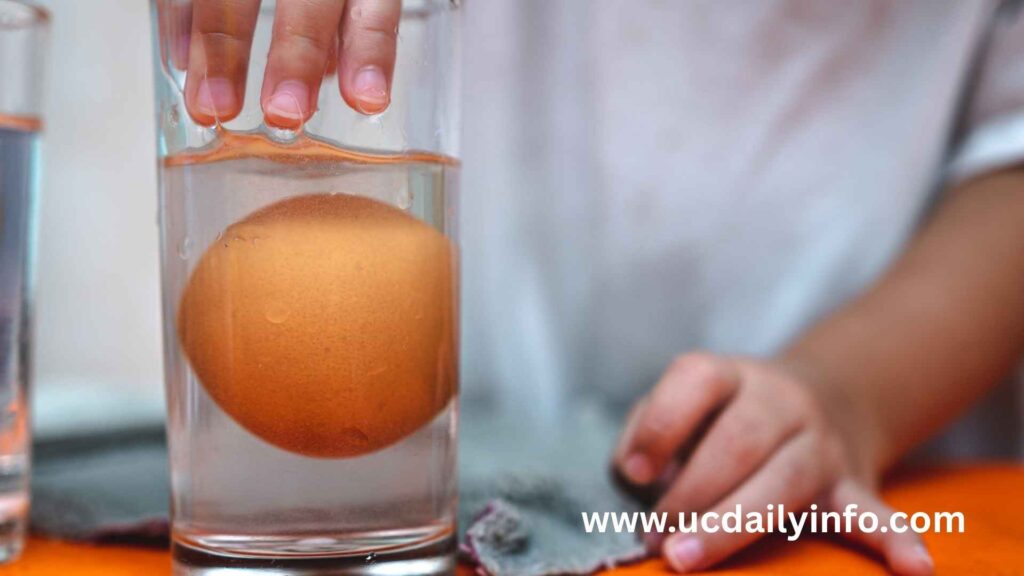
Floating Egg Experiment (Kitchen Science Experiments for Kids)
Ingredients
- Water
- Salt
- Egg
Instructions
- Fill one glass with plain water.
- Fill another glass with water and stir in several tablespoons of salt until dissolved.
- Carefully place an egg into each glass.
You’ll notice that the egg sinks in plain water but floats in the saltwater.
Why Does It Float?
Salt increases the density of water. When the water becomes denser than the egg, it provides enough buoyant force to keep the egg floating.
This experiment introduces children to:
- Density
- Buoyancy
- Comparing liquids
- Observation skills
Make It More Fun
Ask your child to guess:
- How much salt is needed before the egg floats?
- Will warm water change the result?
- What happens with different-sized eggs?
These predictions help children think like real scientists.
Kitchen Science Safety Tips
Although these experiments use common household ingredients, safety should always come first.
Here are a few simple rules to follow:
- Always supervise young children.
- Wash hands before and after experiments.
- Never taste experiment ingredients unless they’re part of a food activity.
- Wear child-sized safety goggles during bubbling or splashing experiments.
- Clean up spills immediately to avoid slips.
- Store ingredients out of reach when you’re finished.
Teaching good safety habits early helps children become responsible young scientists.
Recommended Safety Product
A kids’ science safety set with goggles and child-sized tools helps children feel like real scientists while protecting their eyes during experiments.
👉 Shop kids’ science safety gear:
These easy experiments show that science is everywhere—even in a glass of water, a bowl of mud, or a few simple kitchen ingredients. By encouraging children to ask questions, make predictions, and observe carefully, you’re helping them develop skills they’ll use far beyond the kitchen.
Kitchen Science Experiments for Preschool Children
Preschoolers learn best by touching, mixing, pouring, and exploring. Kitchen science activities are perfect because they encourage curiosity while building early math, language, and problem-solving skills. The key is to choose experiments that are simple, safe, and easy to understand.
At this age, children don’t need to memorize scientific terms. Instead, focus on asking questions, making observations, and celebrating discoveries. Every experiment is an opportunity to build confidence and inspire a love of learning.
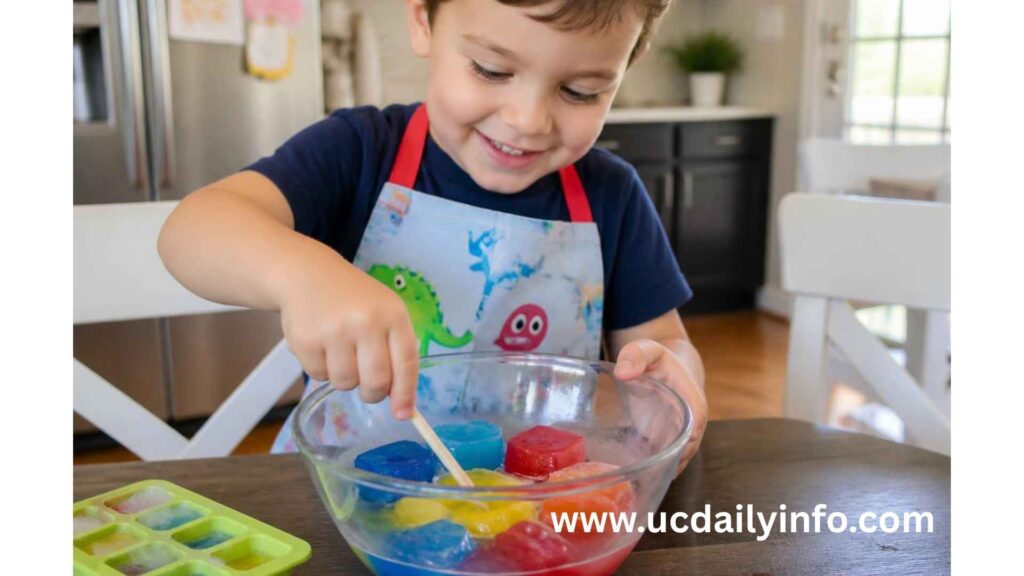
Color-Changing Ice Experiment (Kitchen Science Experiments for Kids)
You’ll Need
- Ice cubes
- Warm water
- Food coloring
Instructions
- Freeze ice cubes with different colors of food coloring.
- Place the colored ice cubes in a clear bowl.
- Pour warm water over them.
- Watch as the colors melt and mix together.
What Children Learn (Kitchen Science Experiments for Kids)
This activity introduces preschoolers to:
- Melting and freezing
- Temperature changes
- Color mixing
- Observation skills
Keep the discussion simple by asking questions such as:
- Which ice cube melted first?
- What new colors did you see?
- Was the water cold or warm?
- What do you think will happen next?
These conversations encourage children to think like little scientists while having fun.
More Preschool Science Ideas
Try these easy activities throughout the week:
- Mixing baking soda and vinegar
- Watching popcorn pop
- Growing celery in colored water
- Making homemade butter in a jar
- Exploring what floats and sinks
- Mixing oil and water
- Observing fruit that sinks versus fruit that floats
Each activity takes only a few minutes but provides valuable learning experiences.
Recommended Preschool STEM Product
A preschool STEM activity book is an excellent way to keep learning going beyond today’s experiments. Many books include simple picture instructions, fun science facts, and activities designed specifically for children ages 3–5.
👉 Browse preschool STEM activity books here:
Related Reading: Looking for more hands-on learning ideas? Explore our guide on Preschool Harvest Activities for fun seasonal crafts and educational games.
Tips for Making Kitchen Science More Educational
You don’t need to be a science teacher to make these activities meaningful. Small changes in how you guide the experiment can make a big difference.
Here are a few simple ways to encourage learning:
- Let your child make predictions before starting.
- Ask open-ended questions instead of giving answers.
- Encourage them to describe what they see.
- Compare results from different experiments.
- Keep a simple science notebook with drawings and observations.
- Repeat favorite experiments using different ingredients to see what changes.
The goal isn’t perfection, it’s curiosity. Children learn best when they are free to explore, ask questions, and even make mistakes.
FAQ
What age is best for kitchen science experiments?
Most kitchen science experiments can be adapted for children ages 3 and up. Preschoolers enjoy simple sensory activities, while older children can explore the scientific explanations in more detail.
Are kitchen science experiments safe?
Yes, when they are supervised by an adult. Always use child-safe ingredients, avoid harmful chemicals, and follow basic safety rules such as washing hands and wearing safety goggles when needed.
What are the easiest kitchen science experiments?
Some of the easiest include:
- Baking soda and vinegar volcano
- Walking rainbow water
- Floating egg experiment
- Rainbow milk
- Dancing raisins
- Color-changing ice
- Oil and water experiment
These require very few ingredients and can usually be completed in less than 20 minutes.
What skills do children learn from Kitchen Science Experiments for Kids?
Kitchen science helps children develop:
- Critical thinking
- Observation skills
- Problem-solving
- Fine motor coordination
- Early math skills
- Communication
- Creativity
- Confidence
These skills support learning in many other subjects as well.
Can Kitchen Science Experiments for Kids be used for homeschooling?
Absolutely. Kitchen science is an affordable and effective way to teach STEM concepts at home. Many homeschool families use these activities as part of their weekly science lessons because they’re engaging, practical, and easy to set up.
Conclusion on Kitchen Science Experiments for Kids
Kitchen science experiments are proof that learning doesn’t have to be expensive or complicated. With just a few everyday ingredients, you can transform ordinary afternoons into exciting opportunities for discovery. Whether your child is making a bubbling volcano, watching colorful water travel between cups, or exploring nature in a mud kitchen, every activity builds curiosity, creativity, and confidence.
The best part is that these experiments encourage families to learn together. Children remember the excitement of making discoveries with their parents far more than memorizing facts from a textbook. By setting aside just a little time each week for hands-on STEM activities, you’re helping your child develop a lifelong love of science and learning.
So gather a few simple kitchen supplies, put on your scientist hats, and start exploring. You never know what amazing discoveries are waiting right in your own kitchen!